Tampilkan postingan dengan label Terowongan. Tampilkan semua postingan

Kamis, 28 September 2017

Kamis, September 28, 2017

Magnetic Reed Switch Probe Extensometer System

Description

The R-4 magnetic probe extensometer consists of an array of magnetic targets, surrounding a common access pipe, positioned at different depths along the length of a borehole or the height of an embankment or fill. A reed switch probe, lowered down the access pipe, de tects the position of the magnet anchors outside the tube. The probe is suspended by a single graduated tape that incorporates the electrical leads. The tape graduation is used to determine the deformation between magnetic anchor points along the pipe's axis.
The magnetic anchors are available in two confi gu rations: leaf spring anchor, for borehole installation, and plate anchor, for embankment or fi ll installation. The leaf spring anchor can be pushed in place or lowe red with the access pipe and released with an external draw wire. The plate anchor consists of a plate with a central hole. The plate anchors are installed with the access pipe as the construction of the embankment or fi ll proceeds. Telescoping access pipes are used where deformations ex ceeding 1% are expected. The R-4 system is compatible with standard inclinometer casings. Roctest Telemac highly recommands using a probe centralizer for repeatable readings. The R-4 system can be used with inclinometer casings.

Feature

The R-4 magnetic probe extensometer is used to measure set tlement of soils at various depths and produce a settle ment profile at a given point to determine:
  • Consolidation of foundation soils
  • Settlement within embankments and dams
  • Deformation around excavations

Spesification


Kamis, September 28, 2017

Unfors Educational Direct Dosemeter EDD-30

Description

The Unfors EDD consists of a small sensor on a cable connected to a display unit. The sensor can measure the dose and dose rate to a specific part of the body, i.e. to eyes, hands, feet, etc.
Kamis, September 28, 2017

TOTAL PRESSURE CELL

Desciption

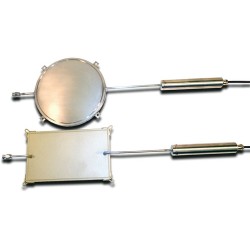
The TPC cells consist of a sealed distribution pad, composed of two plates welded together around the periphery and filled with de-aired oil. The pad is connected via a length of steel tube to a pressure transducer. Variations in oil pressure resulting from load changes acting on the pad are sensed by the transducer. The TPC is fi tted with a circular or rectangular pad, the lat ter being designed for measurement of tangential and radial stresses in shotcrete tunnel linings. The stiffness of the TPC is high, enabling its embedment in soil or in concrete. A groove on both sides of the pad increases its fl exibility while reducing sensitivity to stress in directions other than normal to the pad face. The concrete stress cell may be fi tted with a repressurization
tube to restore contact between the pad and the concrete after curing of the latter. The TPC is fi tted with eyelets, to simplify instal lation, and with a built-in thermistor allowing tempera ture reading.

Feature

  • Long-term reliability
  • High pressure range
  • Different types of transducers available: vibrating wire, electrical 4–20 mA, pneumatic and fiber optic
  • Rugged stainless steel construction for harsh environments
  • Compliant with ISRM suggested method
  • Built-in electrical surge protection
  • Triple water block (watertight connector, resin seal and feed through header)
  • Frequency signal easy to process and transmit over long distances

Spesification

Kamis, September 28, 2017

EMBEDDED VIBRATING WIRE STRAIN GAUGE Model C-110

Description

Long-term reliability
High resolution and accuracy
Rugged: housing resistant to impact and corrosion
Easy to install and use
No maintenance needed
Frequency signal output easy to process and transmit over long distances
Integrated temperature gauge
Watertight to 1500 kPa standard
Frequency measured in sustained or dampened mode
APPLICATIONS
The C-110 strain gauge consists of a thin-wall steel tube with two steel heads soldered to its extremities using solder with a low modulus of deformation. The distance between fl anges of the heads determines the gauge length. A small rectangular housing at the gauge midsection encloses the electro-magnetic excitation and pick-up coils. The electrical resistance of one of the electromagnetic coils provides temperature data, in which case the gauges are delivered with a 5-conductor cable. A 4-conductor cable is used when temperature measurements are not required. Unless specifi ed, gauges are factory-set at mid-range, al lowing one half of the range for measurement of tensile strain, and the other half for compressive strain.

Feature

The C-110 strain gauge is designed for embedment in fine aggregate concrete to measure strain caused by variations in stress. If the modulus of elasticity of the material is known, the magnitude of the strain (other than that induced by loading) can be evaluated. In the case of concrete, the effects of temperature, creep, and the autogenous reaction must be known. Typical examples of concrete structures where vibrating wire strain gauges are used include:
  • Dams
  • Nuclear power stations
  • Bridges and viaducts
  • Large buildings
  • Tunnel linings
  • Piles and caissons

Spesification


Kamis, September 28, 2017

Embedded Strain Gauges EM Series

Description

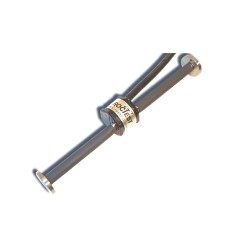
The EM is composed of two end pieces joined by a tube that protects a length of steel wire. The wire is sealed
in the tube by a set of o-rings on each end piece. Both end pieces have a fl at circular fl ange to allow transfer
of concrete deformation to the wire. An electromagnet is fitted at the center of the gauge. Strain developing in
the concrete modifi es the tension in the wire, therefore changing its resonant frequency, which is read by the
electromagnet. The EM-5 is the standard model and is used in different types of structures, as mentionned above. The EM-10 consists of a rugged version to be embedded in concrete with coarse aggregates. The shorter EM-2 model is designed for laboratory use or for limited spaces. Unless specifi ed otherwise, the  gauge tension is factoryadjusted at mid-range. The gauge is very compliant. It does not induce stresses
in the host media and can therefore be embedded in young curing concrete as well as in hard, synthetic materials such as resins, fi berglass and urethane. A thermistor inside the EM supplies information on the
effects of temperature on the materials.

Feature

  • Long-term reliability.
  • High resolution and accuracy.
  • 3000 Microstrain range.
  • Very high compliance.
  • Rugged construction.
  • Temperature reading.
  • Flanges fi tted with mounting holes.
  • Frequency signal easy to process and transmit over long distances.

Spesification

Kamis, September 28, 2017

Water Level Indicator

Description

The CPR is a light and compact unit. It consists of a tape reel, a graduated tape, a control panel and a probe. Visual and audible signals are emitted when the probe comes in contact with water. Control Panel: All models are supplied with a control panel having a full complement of standard accessories. The indicator light provides a clear visual signal when the probe gets in contact with water. The on/off sensitivity switch ensures optimum battery life and allows the operator to compensate for variations in the conductivity of saline or contaminated water. Probe: The probe is specifically designed for either static or water well drawdown measurements. The brass electrode is recessed within a fluted tip to prevent the indicator from sounding prior to contact with the static or pumping water level. A convenient holder is mounted on the reel stand for probe storage. Tape : The flat tape is supplied with standard stainless steel conductors. It is covered with an extruded transparent polyethylene jacket

Feature

  • Robust, light and easy to use
  • 1 mm or 0.01 ft graduations
  • Sensitivity control adjustable to fit water conductivity
  • Battery test button
  • Audible signal and indicator light
  • Powered by 9-volt alkaline battery
  • Smooth tapered probe design
  • Permanent tape graduations
  • Lightweight tape reel with brake